
There are different methods to improve the indoor air quality of your home. What will work best for you will depend on the specific challenges you face and the types of contaminants that tend to circulate in your living space. Your options include the following:
Air Purifier
Air purifiers are the most common devices used for residential indoor air filtration. They work by pulling air from the room, passing it through a filter that traps airborne particles, and then returning the cleaned air to the living space.
Air purifiers can be grouped by the type of filter they use. The two most common options are HEPA and carbon. A HEPA filter (High Efficiency Particulate Air) is made from densely matted, randomly arranged fibers. These fibers are usually nonwoven fabric, polypropylene, or glass.
Their dense and random fiber structure makes it extremely difficult for airborne particles to pass through. A true HEPA filter captures 99.97% of pollutants at the 0.3‑micron size range, including bacteria, viruses, pollen, mold spores, dust mites, and other allergens.
Carbon filters work differently. Instead of trapping solid particles, they capture gases and odors through adsorption. This means airborne chemicals, smoke, VOCs, and lingering household smells cling to the surface of the carbon material as air passes through. While carbon doesn’t remove allergens like pollen or dander, it plays an important role in improving overall air freshness and reducing irritants that can worsen respiratory symptoms.
UV Lights
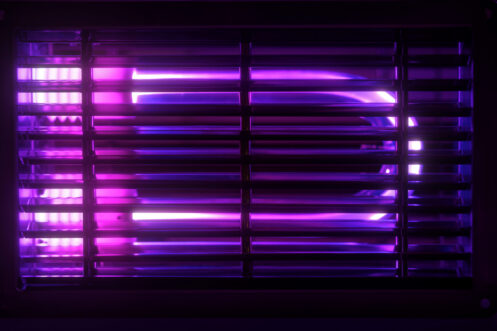
Ultraviolet light, the same type of radiation produced by the sun, can also improve indoor air quality. The sun emits the full spectrum of UV radiation, including UV‑A, UV‑B, and UV‑C, but not all rays reach the Earth’s surface. The ozone layer absorbs most harmful wavelengths.
The form of UV radiation that effectively eliminates indoor pathogens is UV‑C. This wavelength has enough energy to penetrate the cells of microorganisms and damage their DNA or RNA. When bacteria, viruses, or mold spores are exposed to UV‑C light, they lose the ability to grow, reproduce, or cause infection. Because of this, UV‑C systems help reduce mold and other microorganism‑based allergens in your home.
In an HVAC system, UV‑C lamps are usually installed near the evaporator coil or inside the air handler. This placement helps prevent mold growth and reduces the spread of biological contaminants through the ductwork. There are also compact, rechargeable UV-C lamps for room disinfection. However, these are typically used for targeted surface treatment rather than continuous air cleaning.
Air Scrubbers
Air scrubbers, also known as negative air machines, are devices often used in industrial settings to improve air quality. They are stronger and more effective than standard air purifiers because they combine powerful filtration with active purification. While they are commonly seen on construction sites, in restoration projects, and in commercial buildings, there are residential versions designed for homes with serious indoor air concerns.
An air scrubber works by pulling large volumes of air through a series of filters. These usually include a pre‑filter for larger debris, a HEPA filter for fine particles, and a carbon stage for odors and chemical pollutants. After filtration, they release oxidizing molecules into the air. Oxidizing molecules break down contaminants in the air and on nearby surfaces. This dual action makes air scrubbers effective in environments with persistent allergens, smoke, microorganisms, or lingering chemical smells.
Air scrubbers are often integrated directly into your existing heating and cooling system. However, there are standalone units called photocatalytic oxidation scrubbers that you can move from one room to another.
Choosing the Best Air Cleaner for Your Home
All the air-cleaning technologies mentioned above can help reduce allergens in your home, although differently. Your choice will depend on the type of pollutants you are dealing with and your budget. An air scrubber is an all‑in‑one solution that handles particles, odors, and organic contaminants, but it is also the most advanced and typically the most expensive option. A HEPA purifier is the most direct, readily available tool for removing everyday allergens. A UV‑C system, on the other hand, works best for microbial allergens.
Consult a licensed HVAC professional to test your indoor air quality before you decide. A targeted approach helps prevent overspending or investing in equipment that doesn’t address the real source of your symptoms. Your technician will also help you choose the right capacity and placement for your air cleaning device so that it performs effectively and efficiently.
Consult Totally Cool Heating & Air for More Information
With over 35 years of hands‑on experience in indoor air quality solutions, Totally Cool Heating & Air can help you determine which technology is right for your home. Our team in Austin will walk you through the advantages of UV lights in key areas of whole‑house filtration systems. We will also do the installation for you with a guarantee of complete satisfaction.
Call Totally Cool Heating & Air for professional indoor air quality solutions in Austin.
